
Why Celebrities Keep Their Hair at 60 (While You're Losing It at 25)
Jul 21, 2026
If you commented "Roots" on the video, welcome. You asked the right question. Because the truth about celebrity hair is not glamorous, it's not a secret shampoo, and it's definitely not something you'll find on a late-night ad. Let's break it down.
First, the uncomfortable truth about celebrity hair
That 60-year-old actor with a full head of hair isn't lucky. He has three things you probably don't:
A dermatologist on speed dial — who started treating his hair loss early, often in his 30s.
Money and access — for hair transplants, prescription treatments, and procedures done quietly, years before you ever noticed.
A styling team, good lighting, and sometimes hair systems — a lot of "amazing hair" on screen is craft, not biology.
So the real comparison isn't "their genes vs. your genes." It's "someone who treated the problem in year one" vs. "someone who's Googling it in year five." The good news? You can copy the strategy without copying the bank account.

Why you're losing hair in your 20s
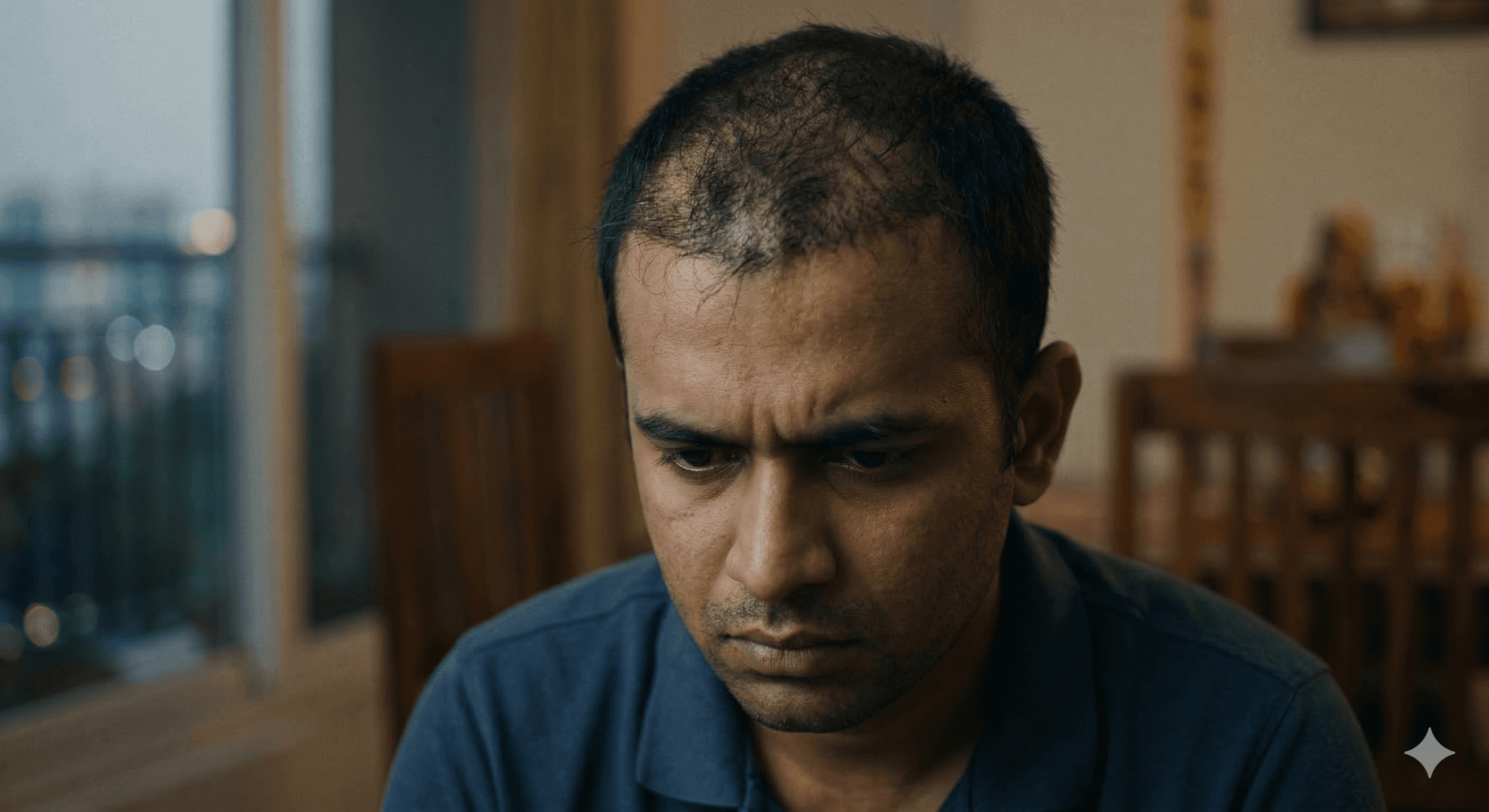
For most people, the answer is androgenetic alopecia — what you'd call male or female pattern hair loss. It's genetic, it's progressive, and it's by far the most common reason young people thin out.
Here's the simple version of the biology:
You inherit hair follicles that are sensitive to a hormone called DHT (dihydrotestosterone).
Over time, DHT causes these follicles to shrink (a process called miniaturization). Each cycle, the hair grows back a little thinner, a little shorter, until it eventually stops.
This usually shows up first at the temples, hairline, and crown in men, and as widening of the part / overall thinning in women.
The single most important thing to understand: you can't regrow a follicle that's already dead. But you can protect and revive the ones that are still hanging on. That's why starting early beats everything. The person who acts at the first sign of thinning always does better than the person who waits.
But not all hair loss is genetic
Before assuming it's pattern hair loss, a good doctor rules out other causes, because these are often reversible:
Iron deficiency / low ferritin (very common, especially in women)
Thyroid problems
Vitamin D deficiency
Telogen effluvium — heavy shedding triggered by illness, surgery, crash dieting, childbirth, or major stress (this usually recovers)
Certain medications and medical conditions
This is why a blood test and a real evaluation matter. Chasing the wrong problem wastes months.


What actually works (the evidence-based list)
These are the treatments with real clinical research behind them. Most work best in combination, and all of them require consistency over months — hair grows slowly, so give any approach a minimum of 4–6 months before judging it.
Minoxidil. The most well-known over-the-counter option (the 5% topical solution or foam). It extends the growth phase of the hair and improves blood flow to the follicle. There's also a low-dose oral version that many dermatologists now prescribe, which some people find easier to stick with. It doesn't work for everyone, and you have to keep using it to keep the benefit.
DHT-blockers (prescription). Finasteride, and the stronger dutasteride, work by lowering DHT attacking the actual cause of pattern hair loss rather than just the symptom. These are among the most effective treatments available, but they're prescription-only for a reason: they have possible side effects, they're not suitable for everyone (for example, women who are or may become pregnant), and they need a doctor's supervision. Don't buy these off a random website get evaluated properly.
Combination therapy. This is the celebrity "secret." Research consistently shows that combining treatments (for example, a DHT-blocker plus minoxidil) works better than any single one alone. Attacking the problem from two angles is the whole game.
Microneedling. When done correctly and paired with minoxidil, it can meaningfully boost results. Not a standalone miracle, but a genuine add-on.
Low-level laser therapy (LLLT) and platelet-rich plasma (PRP) are additional options with growing evidence useful for some people as supporting treatments, best discussed with a dermatologist for your specific case.
Hair transplantation. For areas where follicles are already gone, this is the only way to get hair back there. Modern techniques are excellent and yes, this is what a lot of celebrities have quietly had done. It works best when you also protect your remaining hair with the treatments above, otherwise you keep losing the native hair around the transplant.
What's mostly a gimmick (where your money leaks)
This is the part the ads don't want you to see:
"DHT-blocking" shampoos and most "hair growth" serums. A shampoo is on your scalp for 60 seconds and then rinsed off. The vast majority have no meaningful evidence they regrow hair. Ketoconazole shampoo is a reasonable supporting product for scalp health but even that isn't a standalone fix.
Biotin and hair-growth vitamins. Biotin only helps if you're actually deficient, which is rare. If your levels are normal, extra biotin does nothing for your hair (and it can even interfere with some lab tests). Save your money unless a blood test shows a real deficiency.
Expensive "miracle" supplements and devices with before/after photos and no published trials. Before/after photos are marketing, not evidence.
A fair word on rosemary oil
Since it's all over the internet: there is one small 2015 study where rosemary oil performed similarly to a weaker (2%) minoxidil over six months, with less scalp itching. That's genuinely interesting, and rosemary oil is cheap and low-risk. But it's one small study, it wasn't compared to stronger treatments, and no medical body recommends it as a replacement for proven options. Think of it as a reasonable supporting habit for someone with mild concerns or scalp irritation not a cure for progressive pattern hair loss. If you're actually losing hair, don't bet the farm on an essential oil.
The foundation everyone can control (for free)
None of this replaces treatment, but it gives your hair the best possible environment:
Eat enough protein and don't crash diet — rapid weight loss is a classic shedding trigger.
Fix deficiencies (iron, vitamin D) if a test shows them.
Manage stress and sleep — chronic stress genuinely worsens shedding.
Be gentle — avoid constant tight hairstyles, harsh chemical treatments, and aggressive heat.
The one thing to take away
Celebrities don't have magic hair. They have early action, real treatments, and expert guidance and they skip the gimmicks entirely. You can do the exact same thing on any budget.
If you're noticing thinning, the smartest move isn't buying another serum. It's getting properly evaluated so you know what you're actually dealing with — and starting a proven plan before more follicles are lost. Time is the one thing you can't get back.
Medical disclaimer: This article is for general education and is not a substitute for personalized medical advice, diagnosis, or treatment. Hair loss has many causes, and treatments — especially prescription medications — carry individual risks and benefits. Please consult a qualified doctor or dermatologist for advice specific to your situation before starting any treatment.
Written by
Ram